In this article
Comparing MeetEdgar vs. SmarterQueue? Both are social media scheduling tools built to automate publishing, recycle evergreen content, and help you get more from the content you create.
But they take different approaches. Here's how they compare.
And a quick disclosure: you’re reading this on the MeetEdgar website.
So yes, we’re naturally fond of Edgar. But SmarterQueue is a capable platform, particularly for marketers who want deeper analytics, competitor analysis, and content curation.
In this comparison, we’ll look at pricing, scheduling, evergreen recycling, content variations, AI, analytics, ease of use, and team features to help you decide which platform is the better fit.
MeetEdgar vs. SmarterQueue: quick comparison
If you don’t want to read the full comparison, here’s a TL;DR:
- MeetEdgar is a strong fit if your priority is reducing the repetitive work behind social media. It combines a reusable content library, category-based automation, evergreen recycling, Variations, AI assistance, and unlimited scheduled posts.
- MeetEdgar is especially compelling for small teams. Even its entry-level plan includes up to 20 team members rather than limiting access to a single user.
- SmarterQueue may be the better choice if advanced analytics are central to your workflow. Its higher analytics tier includes features such as best-time-to-post insights, category-level comparisons, competitor analysis, social history analysis, and analytics exports.
- SmarterQueue also has strong content curation and importing tools. That can be valuable if sharing and discovering third-party content is a significant part of your strategy.
- Both platforms support evergreen recycling and post variations. The difference is less about whether they can recycle content and more about the workflow, limits, and controls surrounding that process.
MeetEdgar vs. SmarterQueue features at a glance
MeetEdgar vs. SmarterQueue pricing
At first glance, the two platforms aren't far apart on price.
SmarterQueue has the lower starting price, while MeetEdgar includes more users and fewer scheduling restrictions from the start.
That distinction is important when comparing affordable social media management tools: the cheapest subscription isn't necessarily the lowest-cost option once you account for the number of profiles, users, and posts your workflow requires.
Pricing and features change, so it’s always worth checking each platform’s latest plan details before making a final decision.
MeetEdgar pricing
Current MeetEdgar pricing includes two main plans.
Eddie — $29.99/month or $24.91/month billed annually
Eddie includes:
- 5 social accounts
- Unlimited scheduled posts
- 10 weekly automations
- 4 content categories
- Up to 20 team members
- 15 monthly Inky AI credits
- Additional social accounts available as add-ons
Edgar — $49.99/month or $41.58/month billed annually
Edgar includes:
- 25 social accounts
- Unlimited scheduled posts
- 1,000 weekly automations
- Unlimited content categories
- Up to 20 team members
- 50 monthly Inky AI credits
Both plans currently include a 30-day free trial.
MeetEdgar does not list a plan-level monthly publishing cap. Platform-specific restrictions and limits can still apply, depending on the social network you're publishing to.
SmarterQueue pricing
SmarterQueue currently offers Pro and Team plans, along with customizable options.
Pro — $25/month or approximately $21/month billed annually
Its standard configuration includes:
- 5 social profiles
- 1 user
- 1 workspace
- 10 content categories
- 100 queued posts per profile
- 100 published posts per profile per month
- Basic importing
- Basic analytics
- 10,000 AI text words per month
Team — $50/month or approximately $42/month billed annually
Its standard configuration includes:
- 5 social profiles
- 3 users
- Unlimited workspaces
- 20 content categories
- 250 queued posts per profile
- 200 published posts per profile per month
- Advanced importing
- Advanced analytics
- 25,000 AI text words per month
SmarterQueue also lets customers customize plans by increasing allowances such as users and social profiles.
Its standard trial is currently seven days.
Social media scheduling and automation
This is where the two platforms start to reveal slightly different philosophies.
Both can schedule individual posts.
Both let you organize posts into categories.
Both support recurring schedules.
And both can automatically recycle evergreen posts.
But if you're choosing a social media scheduling tool because you want to spend less time maintaining your scheduler, it's worth looking closely at how each workflow works after the initial setup.
How MeetEdgar approaches scheduling
MeetEdgar is built around the idea that you shouldn't have to manually rebuild your publishing calendar every week.
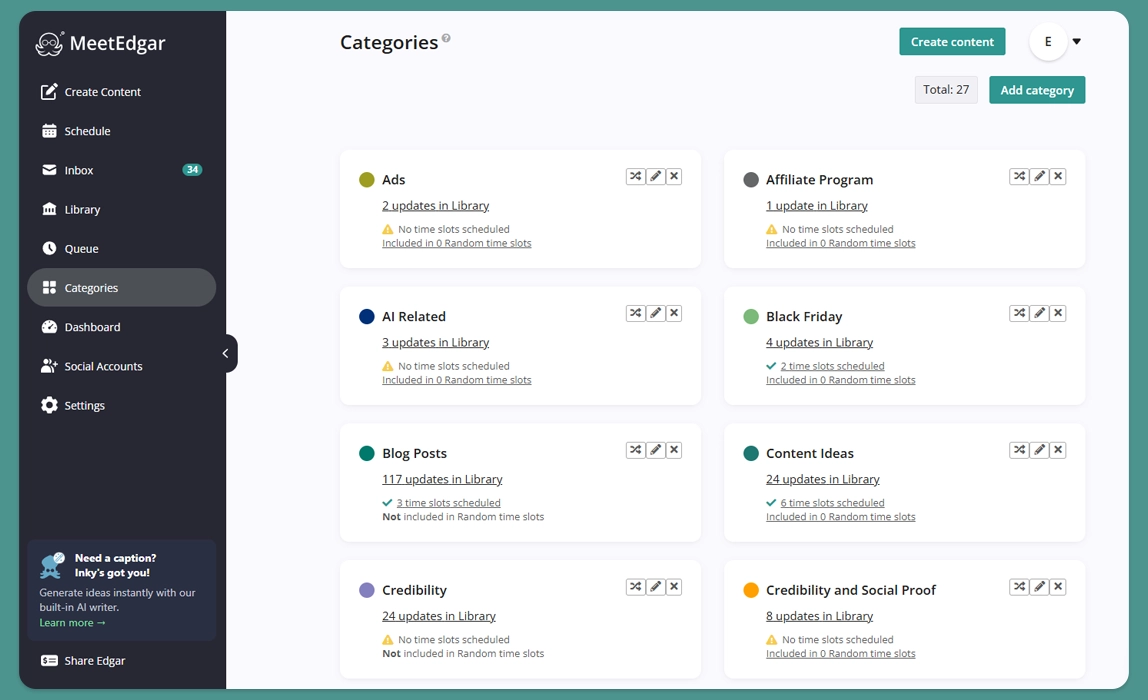
You can organize content into categories such as:
- Blog posts
- Educational tips
- Promotions
- Customer stories
Then you decide when each type of content should be published.
For example, you might schedule educational content for weekday mornings, blog posts a few afternoons per week, and promotional content on Thursdays.
Edgar can then automatically pull content from each category.
Instead of only telling your scheduler: Publish this exact post next Tuesday at 10:15 a.m.
You can create a recurring system that says: Every Tuesday morning, publish something useful from my Tips category.
That's a subtle difference in setup, but it can make a much bigger difference to the ongoing workload.
MeetEdgar combines category-based scheduling with a reusable content library, recurring weekly automations, one-off posts, Variations, and evergreen recycling.
How SmarterQueue approaches scheduling
SmarterQueue follows a similar category-based model through its Posting Plan.
You create categories, assign timeslots, add posts to the queue, and decide whether individual pieces of content should recycle after publishing.
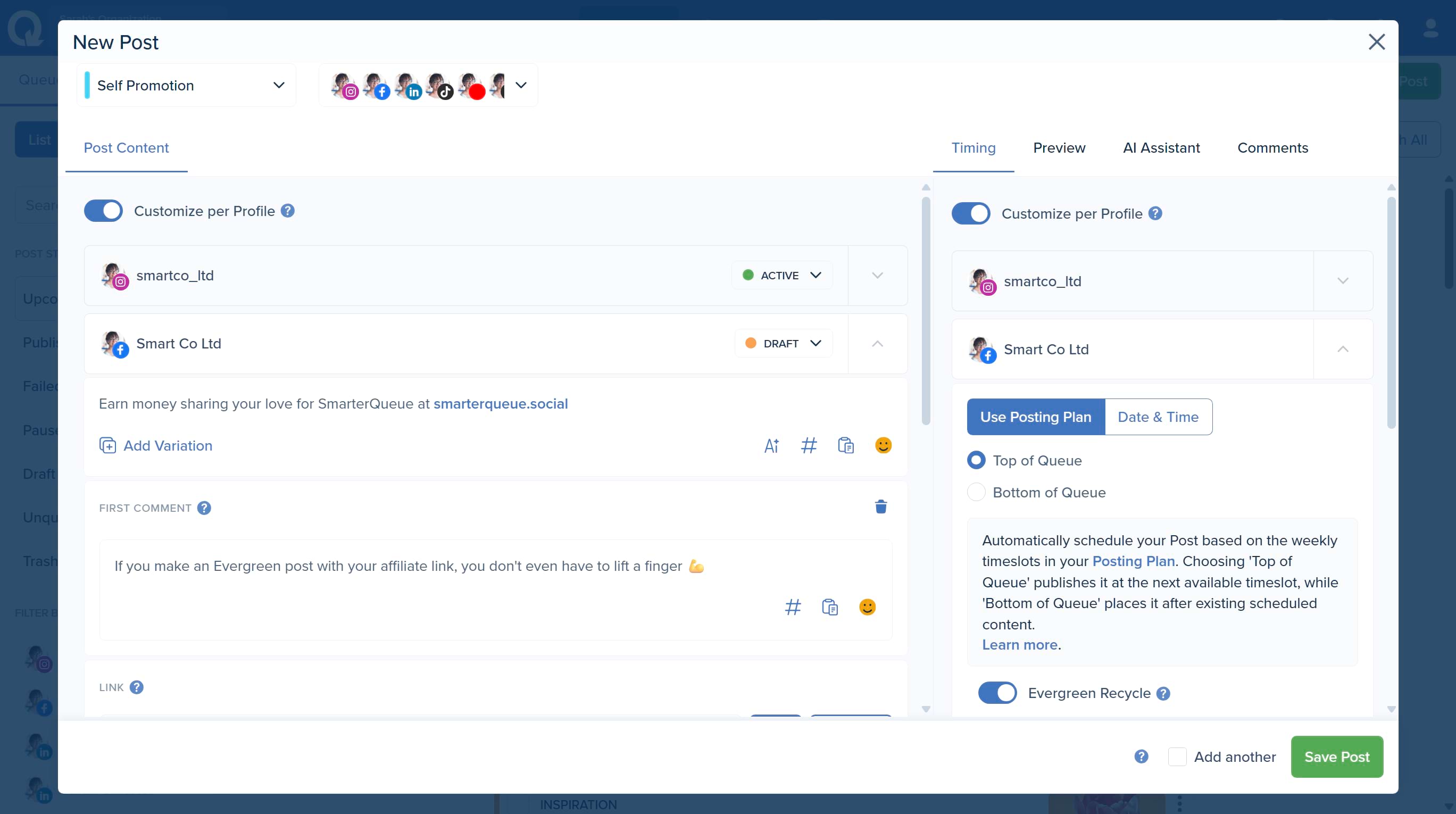
It also offers detailed recycling controls, including minimum recycle intervals, expiration settings, and Variations.
That gives marketers a lot of flexibility over exactly how content moves through the queue.
So if your only requirement is category-based evergreen scheduling, both platforms can do it well.
The difference is more about what you want from the surrounding workflow.
SmarterQueue offers more granular controls in several areas.
MeetEdgar's strength is making the content library, category schedule, Variations, and automated recycling feel like one continuous system.
Evergreen content recycling
Publishing something once doesn't mean its useful life is over.
New followers join your audience, most people don't see every post, and your strongest resources may stay relevant for months or years.
That's why evergreen content works particularly well for businesses that don't want their social strategy to depend entirely on creating something new every day.
Both products genuinely support social media content recycling, and both offer Variations to avoid simply publishing identical updates again and again.
MeetEdgar stores posts in a reusable content library and can continue pulling evergreen updates into your recurring schedule.
SmarterQueue can also return evergreen posts to the queue and gives you controls over recycling intervals and expiration.
So the question isn't whether either platform can recycle content. They both can.
The more meaningful difference is how recycling fits into the rest of the workflow.
MeetEdgar combines recycling with categories, a reusable social media content library, and Variations — which makes it particularly useful if you want evergreen content to form the foundation of an automated publishing system.
Content repurposing and Variations
This deserves its own section because recycling and repurposing aren't exactly the same thing.
Recycling is about how can you share this useful post again.
Repurposing is about how many useful social posts you can create from this one idea.
That's where Variations become particularly valuable.
With MeetEdgar, multiple variations can be grouped around the same underlying piece of content.
Say you spent six hours creating a detailed article. The social promotion for that article doesn't need to consist of one caption copied into a scheduler. A single article might give you ten useful social posts.
That's the real value of Variations: the original content becomes an asset you can continue working from rather than a one-time social post.
With MeetEdgar, you can add this article link into the content composer and it will generate many automatic suggested variations as you want. MeetEdgar can then store those variations in the library and rotate them through the appropriate category.
For a small business with limited content-creation time, that's often a much more sustainable strategy.
So again, Variations themselves aren't exclusive to MeetEdgar.
The MeetEdgar advantage is the way Variations fit into the larger content-library workflow: create different versions, organize them, keep them available, and let your recurring schedule continue putting them to work.
Creating social content with AI
Both tools include AI assistance, though they package it differently.
MeetEdgar's AI assistant, Inky, can generate caption suggestions from a prompt and optionally suggest hashtags.
It becomes especially useful alongside Variations: you can use AI to explore another way of expressing an idea, refine the suggestion, and save it as another version of your content.
If you're experimenting with AI social media captions, this can help reduce blank-page time without replacing your own voice.
SmarterQueue's AI Assistant also supports caption generation, rewriting, tone adjustments, hashtags, and post variations.
Verdict: AI probably shouldn't decide this comparison on its own. Both tools cover the basics well.
Content importing and curation
MeetEdgar can bulk-import content and pull new material from RSS feeds, which is useful if you already publish blog posts, podcasts, videos, or other regularly updated content.
That can help businesses looking at how to automate social media content turn existing resources into a reusable publishing library.
SmarterQueue goes further into third-party content discovery and curation, with more advanced importing and filtering options.
Verdict: SmarterQueue has the advantage if content curation is a major part of your strategy. MeetEdgar is more focused on organizing, repurposing, and redistributing your own content.
Ease of use
Both tools use categories, recurring schedules, and evergreen queues, so there’s some setup involved either way.
MeetEdgar keeps the workflow focused around your Library, Categories, Schedule, and Queue. Once those are set up, the goal is to spend less time actively managing your calendar.
SmarterQueue is also user-friendly, but offers more configuration across scheduling, curation, analytics, and recycling controls.
Verdict: MeetEdgar is the better fit if you value simplicity and a lower-maintenance workflow. SmarterQueue may appeal more if you prefer granular control and more settings to customize.
Analytics and reporting
MeetEdgar provides performance metrics to help you understand how your published content is performing.
Because MeetEdgar supports multiple versions of a piece of content alongside analytics, you can compare how different versions perform over time.
SmarterQueue goes considerably deeper if detailed reporting is important to you.
Its competitor analysis tools are particularly notable if monitoring other brands is part of your social media role.
SmarterQueue wins on analytics depth. If you're a social media manager who regularly analyzes competitors, compares category performance, or needs more detailed reporting, that may be a meaningful reason to choose it.
Managing social media as a team
This is one of the clearest differences between the standard plans.
MeetEdgar includes up to 20 team members on both Eddie and Edgar.
SmarterQueue's standard Pro configuration includes one user, while Team includes three. Additional users can be added by customizing the plan.
For a one-person business, this difference may not matter today.
But social media workflows often grow.
When that happens, pricing based only on the number of social profiles can stop telling you the whole story.
Supported social networks
MeetEdgar currently supports:
- TikTok
- X/Twitter
- Google Business Profile
- Threads
- YouTube Shorts
- Bluesky
SmarterQueue currently supports:
- TikTok
- YouTube
- Threads
- X/Twitter
- Google Business Profile
For most businesses, either platform covers the major social networks.
One notable difference in the current native support lists is Bluesky, which MeetEdgar supports directly.
MeetEdgar vs. SmarterQueue: which should you choose?
There isn't one correct choice for every person, and that's okay. Both tools are very similar in many aspects.
They share an important idea:
Social media shouldn't require you to create and manually schedule every post from scratch forever.
Both use categories, scheduling, evergreen recycling, AI, and Variations to reduce repetitive work.
If your main reason for paying for a scheduler is to spend less time repeatedly filling and maintaining a social media calendar, MeetEdgar has a particularly strong proposition. It helps you turning the content you already have into an automated, reusable social media system.
So if sophisticated competitor analysis, detailed reporting, or advanced content curation is at the top of your list, SmarterQueue deserves serious consideration.
FAQ
What’s the difference between MeetEdgar and SmarterQueue?
MeetEdgar is built around saving time through automation: you create a reusable content library, organize posts into categories, and let Edgar keep your schedule moving with recurring weekly automations. SmarterQueue also supports categories and evergreen recycling, but it tends to lean more heavily into advanced analytics, content curation, and granular reporting. If you want a simpler system that keeps publishing without constant hands-on scheduling, MeetEdgar is usually the more natural fit.
What social media platforms do MeetEdgar and SmarterQueue support?
MeetEdgar supports major social platforms including Facebook, Instagram, TikTok, LinkedIn, Pinterest, X/Twitter, Google Business Profile, Threads, YouTube Shorts, and Bluesky. SmarterQueue also supports many of the major networks, including Facebook, Instagram, TikTok, YouTube, Threads, X/Twitter, LinkedIn, Pinterest, and Google Business Profile. Exact supported post types can vary by platform, so it’s worth checking the formats you use most, such as Reels, carousels, Shorts, or videos.
Is MeetEdgar cheaper than SmarterQueue?
Not always at the entry-level sticker price. SmarterQueue’s Pro plan starts lower than MeetEdgar’s Eddie plan. But MeetEdgar includes more built-in room for teams and scheduling: Eddie includes up to 20 team members and no MeetEdgar plan-level cap on scheduled posts. So the better value depends on how many users, social profiles, and scheduled posts you need. For small teams or businesses that publish consistently, MeetEdgar can become the stronger value quickly.
Which is better for evergreen content: MeetEdgar or SmarterQueue?
Both tools can recycle evergreen content, so this isn’t a one-sided comparison. The difference is workflow. MeetEdgar’s content library and recurring category-based automations are designed to make evergreen publishing feel hands-off: add your best content, organize it by category, and let Edgar keep pulling from that library over time. SmarterQueue also offers evergreen recycling with detailed controls, but MeetEdgar is especially strong if your goal is to reuse your own best content with less weekly maintenance.