In this article
Creating great content is only half the battle on LinkedIn. If you want your posts to reach more of the right people, you also need a strategy for when and how you publish, how you engage with your audience, and how you get more value from the content you've already created.
But most LinkedIn advice is guesswork dressed up as certainty. So let's start somewhere solid: with what LinkedIn itself says works.
In this article, we will explore posting tips to help you increase your LinkedIn post performance. We'll unpack each habit LinkedIn recommends, explain why it works, and show you how to turn it into a repeatable system you can actually maintain.
LinkedIn Posting guidelines
In a recent post, the LinkedIn for Marketing team laid out the habits that actually move the needle on reach.
They shared a four-point list of "habits that make a difference": publish consistently, engage with comments quickly, repurpose your best-performing content, and experiment with different formats.
These recommendations offer a useful starting point for building a LinkedIn content strategy that is both sustainable and focused on performance. Here's how to put them into practice.
LinkedIn's Content Performance habits:
✓ Post 2–3 times per week
✓ Engage with comments within the first hour
✓ Repurpose your top-performing content
✓ Mix up your content formats
These four tips may seem simple, but putting them into practice consistently can make a meaningful difference in how you approach your LinkedIn content. Each one addresses a different part of the content performance equation—from getting your posts in front of your audience to encouraging conversations and making the most of the content you've already created.
Let's explore these LinkedIn posting tips in more depth and look at how you can turn them into a sustainable content strategy for your brand or personal profile.
The 4 pillars of a strong LinkedIn content strategy
1. Post Consistently
Consistency is one of the most important parts of building a recognizable presence on LinkedIn.
LinkedIn is explicit that consistency is "one of the biggest drivers of reach." Posting regularly tells the algorithm you're an active, valuable contributor - and that signal compounds over time.
The reason this works comes down to how the platform distributes content. The LinkedIn algorithm functions as a recommendation engine that scores every post against hundreds of signals before deciding how far to push it. Creator authority and topical consistency are part of that scoring, so an account that shows up reliably, on a recognizable set of themes, gives the algorithm more reasons to distribute its posts.
The trap most people fall into is starting too big. They commit to daily posting, keep it up for two weeks, then vanish for a month. That inconsistency does more harm than a modest, steady cadence.
If you're not sure what's realistic, our guide to how often you should post on LinkedIn is a useful gut-check.
The key is to find a schedule you can maintain.
A content calendar can make this process much easier. Instead of wondering what to post each day, you can plan your topics in advance and create a balanced mix of content.
Consistency also becomes easier when you separate content creation from content publishing. You can create several posts at once, organize them in a content library, and schedule them to publish throughout the week.
If you're looking for a practical way to manage this process, MeetEdgar's guide on how to schedule LinkedIn posts walks through both LinkedIn's native scheduling options and how a social media scheduling tool can help you plan and automate your publishing workflow.
2. Engage with comments
Publishing is the start of the conversation. LinkedIn specifically recommends engaging with comments during the first hour after a post goes live.
Replying to comments in that first hour does two things:
- It keeps the conversation active (and conversation depth is one of the strongest amplification signals LinkedIn uses),
- And it pulls the commenter back for a second interaction. Both tell the algorithm your post is generating real discussion, not just passive scrolls.
Reserve some time to treat as community time: Answer questions, acknowledge useful perspectives, and ask a natural follow-up when a comment opens a deeper discussion.
Plan for this before you schedule. If nobody can monitor the discussion at 7:00 a.m., that is probably not the right publishing time for your team, even if a generic benchmark says it is.
3. Repurpose your top-performing content
A strong post should not disappear after one turn in the feed. LinkedIn recommends repurposing top performers in new formats. The key phrase is new formats: repurposing is not simply publishing the same caption again.
Repurposing content for social media is a great way to crate multiple posts from one core idea intact. You can start with a post that earned meaningful results, identify the idea that resonated, and rebuild it for another way of consuming information.
For example, one successful LinkedIn text post can become:
- A document carousel that turns the argument into five clear steps
- A short native video that demonstrates the process
- A poll that tests the audience’s experience with the problem
- A founder story explaining how the lesson was learned
- A follow-up post answering the best question from the comments
The practical move: once a month, look at your best-performing post and rebuild it in a different format. Then add your evergreen winners to a library you can re-share on a schedule instead of letting them disappear after one day in the feed.
4. Mix up your LinkedIn content formats
The final recommendation in LinkedIn's checklist is to experiment with different content formats.
Your audience doesn't consume every piece of content in the same way. That's why LinkedIn for Marketing recommends mixing up your content, including text posts, carousels, and video.
Experimenting with different formats can help you discover what resonates with your specific audience.
Text Posts
Text posts are a straightforward way to share an opinion, tell a story, explain a lesson, or start a conversation. They're particularly useful for thought leadership and personal perspectives.
Try sharing:
- A lesson you've learned
- An opinion on an industry trend
- A common mistake your audience makes
- A short story with a practical takeaway
- A question about a topic your audience cares about
Carousels
Carousels can be useful for breaking down complex information into easy-to-follow steps or presenting several related ideas.
Consider using them for:
- Step-by-step guides
- Checklists
- Tutorials
- Data and insights
- How-to content
- Lists of tips
Video
Video can help bring personality and context to your content. You might use short-form video to explain a concept, share an insight, introduce your team, or respond to a common question from your audience.
You don't need to choose one format and stick with it forever. Instead, test different formats and pay attention to how your audience responds.
How to improve LinkedIn content visibility in AI-powered discovery
LinkedIn’s post also points marketers toward guidance on the AI visibility of posts. The durable principle is the same one that improves human usefulness: publish clear, specific expertise that can stand on its own.
To make your content easier to understand, retrieve, and attribute:
- State the topic and takeaway clearly instead of relying on a vague teaser.
- Use the language your customers and peers use for the problem, without stuffing keywords.
- Include concrete examples, original observations, or a named framework that adds value beyond a summary.
- Keep your profile and company information accurate so readers can understand who is speaking and why their experience is relevant.
- Link to a useful supporting resource when the reader needs evidence, detail, or the next step.
- Publish consistently enough to build a coherent body of expertise around your core topics.
Do not write for an imagined machine at the expense of the reader. Clear expertise, trustworthy sourcing, and a satisfying answer are the foundation of visibility in both traditional and AI-assisted discovery.
LinkedIn Posting Checklist
The four habits above are about your overall cadence and strategy. But LinkedIn also shares a separate posting checklist: a quick-reference for what makes an individual post work once you sit down to write it. This one is about post craft, not strategy.
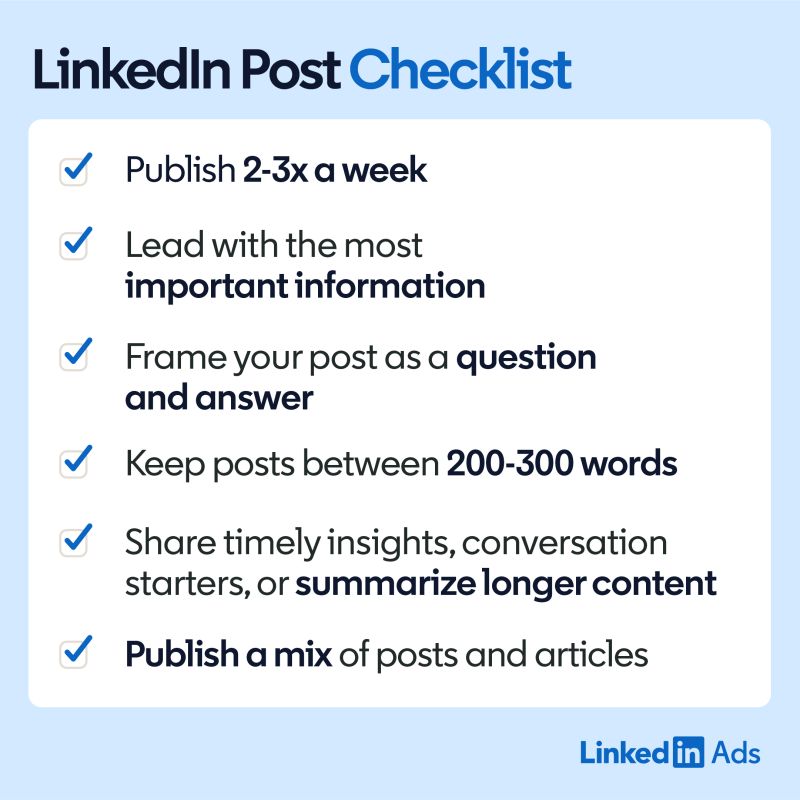
To keep it accessible, here's LinkedIn's checklist in full:
- Publish 2–3x a week — the same consistent cadence the habits above emphasize.
- Lead with the most important information — put your hook and key point in the first line or two, before LinkedIn's "…see more" cutoff, so people get the value without having to expand the post.
- Frame your post as a question and answer — pose the question your audience is actually asking, then answer it. This mirrors how people search and gives them a reason to engage.
- Keep posts between 200–300 words — long enough to say something useful, short enough to stay scannable in a busy feed.
- Share timely insights, conversation starters, or summaries of longer content — give people a reason to stop, react, or weigh in.
- Publish a mix of posts and articles — combine short-form posts with longer-form LinkedIn articles to reach different reading habits.
Two of these ("publish 2–3x a week" and "publish a mix" ) echo the habits from earlier, which is a good sign the two lists reinforce each other. The genuinely new material here is about how you write each post: leading with your key point, the question-and-answer structure, the 200–300 word sweet spot, and choosing timely, discussion-worthy angles.
Think of it this way: the four habits are your strategy, and this checklist is your pre-publish gut-check for every individual post.
How to turn these habits into a repeatable system
LinkedIn's four habits are the what. The reason most people still struggle is the how — specifically, keeping it up when work gets busy. A strategy you abandon in week three isn't a strategy.
The fix is to stop treating posting as a daily task and start treating it as a weekly (or monthly) batch. Here's a simple system:
- Plan your themes. Decide the handful of topics you want to be known for. Finding your content pillars gives your personal or professional brand focus, saves time on brainstorming, and establishes your authority
- Batch-create. Set aside one focused block to write several posts at once instead of scrambling daily. Batch creating for social media is far more efficient than starting cold every morning.
- Schedule ahead. Queue your posts so your 2–3-per-week cadence runs whether or not you're inspired that day. You can bulk scheduling your social media posts to make this workflow seamless.
- Recycle your winners. Add your best evergreen posts to a content library that automatically re-shares them over time — which is exactly the "repurpose top-performing content" habit LinkedIn recommends, made automatic.
This is the part MeetEdgar was built for. Its content library stores your best posts by category and recycles them on a schedule, so a chunk of your cadence fills itself — you're not writing every post from scratch, which is the single biggest reason people fall off their LinkedIn strategy.
That's where a system beats motivation. Start your 30-day free trial of MeetEdgar → batch a week of LinkedIn posts in one sitting, automatically recycle your best content, and keep your strategy running without the daily grind. No credit card required.