In this article
You spent an hour crafting that post. You found the right image, wrote the caption, agonized over the call to action, and hit publish. Then... a handful of likes from the same people who always like your stuff, and silence.
Here's what's actually going on: the algorithm didn't hide your post because it was bad. It hid it because that's how social media works now. And if you're only posting content once, you're leaving most of your audience in the dark every single time.
An evergreen social media queue is the fix — and it's simpler than it sounds.
Less Than 5% of Your Followers See Your Posts
Let's start with the uncomfortable reality.
On Instagram, the average post reaches just 3.5% of a brand's followers — and that number dropped another 12% between 2024 and 2025, according to Socialinsider's social media reach analysis. Facebook is even harsher: organic reach hovered around 1.37% in 2024. That means if you have 1,000 followers on Facebook and you post once, roughly 14 people see it.
The exception is LinkedIn, where personal profiles can still reach 20–30% of their network. But for most platforms, the math is brutal.
The natural response is to post more. But creating net-new content every day isn't sustainable for most businesses — especially small teams and solopreneurs already stretched thin. That's where a smarter approach comes in: instead of creating more content, you make your existing content work harder.
An evergreen queue makes that automatic.
What Is a Evergreen Social Media Queue?
Before getting into the "evergreen" part, it helps to understand what a social media queue actually is — because it's often confused with a content library.
A content queue vs. a content library: what's the difference?
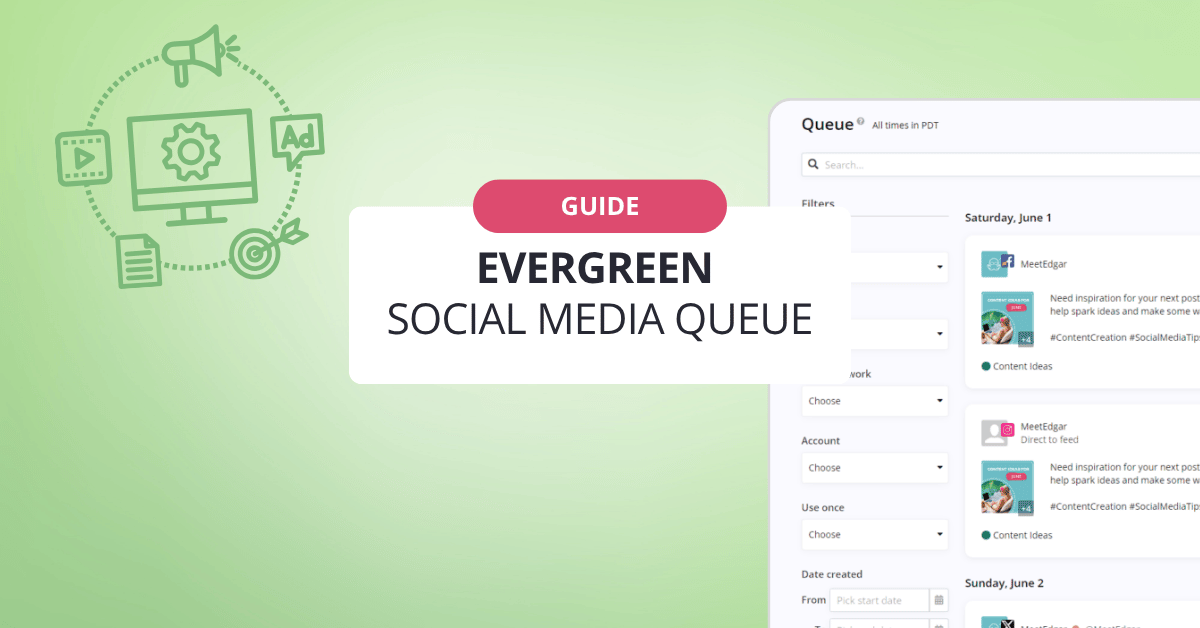
Think of it this way: your content library is the storage room. It's where all your posts live — organized, tagged, and ready to be used. Your social media queue is the conveyor belt. It's the scheduling mechanism that decides which posts leave the storage room and when they get published.
Most basic scheduling tools let you manually place posts on that conveyor belt one at a time. You pick a post, set a date and time, it publishes, and it's gone from the queue. The post has done its job and moves no further. The next post has to be placed manually.
An evergreen social media queue works differently. Instead of single-use scheduling, posts that are "evergreen" — meaning they're not tied to a specific date or trending moment — automatically cycle back to the queue after they're published. They go from storage, to the conveyor belt, to your feed, and then back to storage to wait for their next turn.
This is what makes the queue self-sustaining. You load it once (or add to it regularly), and it keeps publishing content indefinitely without running dry.
Evergreen content is the category of content that makes this possible. It's any post that will still be relevant in six months: a quick tip, a how-to, a testimonial, a stat, a quote. Contrast that with time-sensitive posts — a flash sale, breaking news, a trending topic — which are valuable once and shouldn't be recycled.
An evergreen queue holds the timeless stuff and keeps recirculating it. Time-sensitive content gets scheduled once and expires naturally.
Why Evergreen Beats a Post-and-Forget Strategy
The "post-and-forget" approach treats every piece of content as a one-time event. You create it, publish it, and move on. For some content types, that's the right call. But when you apply that logic to evergreen content — your best tips, your most-shared how-tos, your most relatable observations — you're throwing away compounding value.
Here's why an evergreen queue outperforms one-and-done posting:
- You increase your chances of reaching your audience. A significant chunk of your audience is offline when you post. If you only publish once, they never see it. Recycle the same post a few weeks later at a different time slot, and you're effectively reaching a new segment of your audience with content they haven't seen.
- Your audience grows. Someone who follows you today didn't see anything you posted six months ago. Recycling your best content means new followers actually benefit from your expertise rather than only seeing what you happen to create this week.
- Content recycling doesn't feel repetitive to readers the way it does to you. You see every post you've ever created. Your average follower sees a tiny fraction of them. What feels like "reposting the same thing" to you is often brand-new to most of your audience.
- It saves time without sacrificing quality. Instead of scrambling to produce something new every day, you're building a library of high-quality posts that keep delivering value on their own. The upfront investment pays dividends every time Edgar recycles a post you wrote months ago.
Won't my followers notice I'm reposting the same content?
Unlikely. With organic reach sitting around 3.5% on Instagram and 1.37% on Facebook, most of your followers never saw the post the first time. Even frequent followers would have to scroll back months to catch a recycled post — and most won't. The posts that do get seen again by the same person are usually still relevant and worth the reminder.
The key is balance: an effective strategy mixes evergreen content (the foundation of your queue) with fresh, timely content added regularly. The evergreen queue handles the baseline so you're never silent — and you use your content creation energy for what only you can write right now.
What to Put in Your Evergreen Queue
Not all content belongs in an evergreen queue. Time-sensitive posts — anything tied to a specific date, a trending conversation, or a limited-time offer — should be scheduled once and left to expire. Everything else is a candidate.
Here's a breakdown of what works well:
For help turning long-form content into queue-ready posts, the guide on how to repurpose a single blog post into 10 pieces of content is a good place to start. And for inspiration on what to actually post, evergreen content examples covers a wide range of formats and industries.
A strong evergreen queue typically has 20–40 posts per active category before you start letting it run on autopilot. That gives you enough variety that the recycle loop isn't immediately obvious, and enough cushion that the queue never runs dry between content creation sessions.
What content shouldn't go in an evergreen queue?
Anything with a specific date, a deadline, a price that may change, or a reference to a trending news event. Seasonal promotions, limited-time offers, event announcements, and commentary on current events are all best scheduled once and left to expire.
Stop Creating Content That Disappears
The algorithm isn't going to start showing your posts to more people by default. Organic reach has been declining for years and there's no sign of that trend reversing. But you don't need the algorithm to be more generous — you need a system that makes each piece of content work over and over again.
That's exactly what an evergreen social media queue does.
MeetEdgar is built from the ground up for this kind of automation. The content library, the category system, the time slots, the LIFO queue logic, the auto-recycling, and Inky's AI assistance for creating variations — it's all designed so you can set up a queue once and let it run, while you focus on the parts of your business that actually need your attention.
Try MeetEdgar free for 30 days and build your first evergreen queue and see what it feels like when your content actually keeps working.