In this article
AI is everywhere now and if you create social media content, you’re probably already using it or at least considering it.
But sometimes, while scrolling, you come across a caption that just feels off. It is too polished, too generic, or too predictable. Something about the rhythm gives it away before you can explain why. Then you check the account and realize it belongs to a brand you used to trust.
As AI adoption grows, so does consumer skepticism toward brands that rely too heavily on AI-generated content. That leaves marketers with an important question: How can you use AI without losing your brand’s personality or sounding robotic?
In this article, we’ll explore how to sound authentic and more human on social media using AI, including practical ways to preserve your voice, build trust, and create content that still feels less robotic and AI-generated.
Why "sounds like AI" is turning into a red flag
Audiences have gotten good at spotting AI-written content, and their patience for it is thinning.
Cashew Research's August 2026 survey of 2,149 consumers across the US and Canada found that 87% believe brands use at least some AI generated content, with 79% of consumers still prefer authentic brands, but authenticity on its own has stopped being a differentiator and has become the baseline expectation, alongside things people can actually verify, like real customer stories and product quality. In a similar find, a global study from Meltwater and YouGov covering nearly 10,000 consumers across seven markets, 32% said they would trust a brand less once they learned its content was AI generated.
None of that means AI is off the table, though. What actually erodes trust are the visible seams: the generic phrasing, the tone that hedges everything, the sentence that could belong to any business on earth. The tool itself isn't really the problem so much as unedited, unvoiced output is.
That's good news if you're running things solo or with a small team, because the fix isn't doing more manual work forever. And AI tools like an AI caption generator, can be a time saver. It just takes a handful of habits that keep AI limited to drafting, while you stay the person who decides what actually goes out.
What "sounding authentic" actually means here
Authentic AI content, for social media, that AI helped shape but that still carries the details, stories, and phrasing only you could have come up with, reviewed by an actual person before it goes live. It's about making sure the specific, the true, and the you survive the drafting process instead of getting smoothed away.
Most posts that read as authentic still had AI involved somewhere, whether that meant brainstorming angles, generating hashtags, tightening a sentence, or suggesting a hook. The real line isn't AI versus no AI, but whether a real person's judgment shaped what finally got published. If you've been tempted to reach for an AI humanizer tool as a shortcut, it's worth knowing that these tools smooth out tone but can't add a detail or an opinion that was never there to begin with, so the habits below will get you further without paying for another subscription.
Building this kind of consistency also connects to something bigger than any single caption, which is having a clear, defined brand voice that stays recognizable across every platform you post on.
8 obvious signs you're using AI
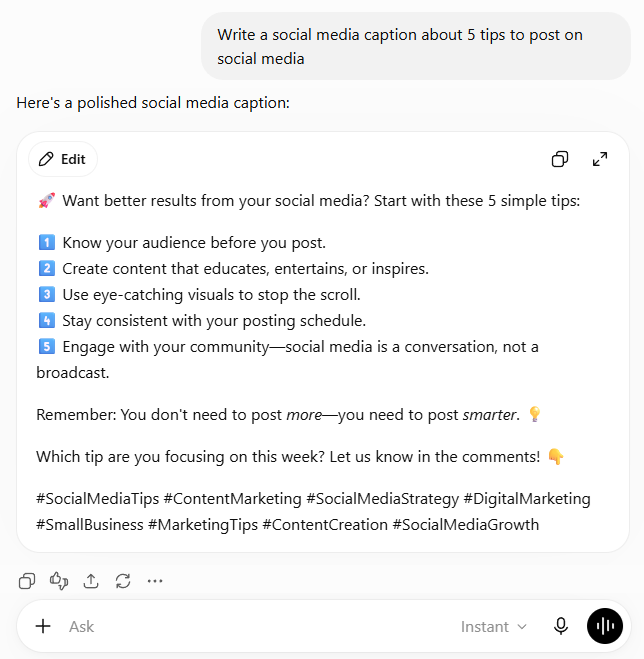
Yes, people can easily sport an "AI slop" nowadays... especially when the content has these common signs, such as:
1. It reaches for the same handful of words: Terms like "elevate," "unlock," "leverage," "seamless," and "game-changer" show up across totally unrelated posts, because these are exactly the crutches covered in tip 5 above. If you scan your last ten captions and see the same three or four words repeating, AI probably wrote more of them than you realized.
2. It asks questions nobody would actually answer: Lines like "Ever wonder what sets successful brands apart?" aren't really questions, they're a rhetorical device AI reaches for to sound conversational. A real question invites a real answer, so if nobody would actually type a reply to it in the comments, it's worth cutting.
3. It has em dashes (—) everywhere: A dash here and there is normal, but AI tends to drop one into nearly every other sentence, using it to bolt on an afterthought instead of writing a proper sentence or clause. If a text has two or three dashes standing in for commas, periods, and full ideas, that's a strong tell, and it's exactly the habit this article is trying to avoid in its own writing.
4. It keeps saying "that's not X, that's Y.": This kind of negative parallelism sounds punchy the first time and formulaic by the third. A content that leans on constructions like "this isn't just a product, it's a lifestyle" is usually reaching for drama instead of saying something specific.
5. It sounds impressive but says nothing specific: "We're passionate about helping you succeed" could be pasted onto any business in any industry, since nothing in it proves a real person or a real experience is behind it. If you deleted your logo from the post, would a customer still recognize it as yours? If the honest answer is no, that's a sign.
6. It forces analogies or metaphors: AI likes to compare a business to a journey, a symphony, or a puzzle piece, even when the comparison falls apart under a second look. If an analogy needs to be explained before it makes sense, it probably wasn't earning its place in the post.
7. It overexplains little things: Sometimes, it makes simple ideas too complicated because AI tends to add unnecessary details and explanations, turning something that could be said in one sentence into a much longer passage.
8. It could belong to any business in your niche: Does it sounds generic? If a competitor could publish the exact same caption with their logo swapped in and nobody would notice, the post is missing the one thing AI can't generate on its own, which is something that only happened to you.
7 ways to keep your voice when you use AI for social posts
Now that you’ve learned some of the common signs of AI-written content, let’s explore how to keep your content feeling authentic, human, and true to your voice.
1. Feed it your own words
A blank prompt usually produces a blank-sounding caption. Asking for "a caption about time management" gets you filler, since the model has nothing of yours to work from.
Instead, give it examples of how you already communicate. You might paste in:
- Three social posts you’re proud of
- A recent email to a customer
- A voice-note transcript
- Part of a podcast or video transcript
- A rough paragraph you wrote without AI
Then explain what you want it to preserve. Don’t just say, “Match my style.” Point out the parts that matter: short sentences, dry humor, direct advice, occasional asides, or a lack of corporate language.
Too vague:
Write an Instagram caption about consistency.
More useful:
Here are three captions I’ve written before: [paste captions].
First, identify the patterns in my writing, including sentence length, tone, vocabulary, and humor. Then write a new caption about why I stopped posting every day and started batching my content instead. Keep it casual and slightly self-deprecating. Use short paragraphs, avoid motivational clichés, and don’t make me sound like a productivity expert.
The more of yourself you put into the prompt, the less work you’ll have to do later to remove the generic AI tone.
If you want a deeper library of prompts to steal, this guide to using ChatGPT for social captions has a reusable brand-voice prompt template you can copy and fill in.
2. Use the output as a starting point/draft
AI is useful for getting an idea into shape. It can suggest a structure, organize your thoughts, or give you five possible opening lines. But the first draft is usually the most generic version.
Let it get you unstuck on structure or a rough opening line, and then rewrite the parts that carry your opinion, your humor, or your specific take, since the fastest way to sound like everyone else is to publish the first thing AI hands back without touching it.
AI draft: "Consistency is key to social media success."
Edited: "I used to think posting every day was the secret. It's not: batching one solid week beats seven rushed days, every time."
The idea stays the same, but it's now an opinion instead of a truism.
Before publishing, look for the parts of the post that should carry your perspective. That might be the opening, the main argument, a joke, an example, or the conclusion. Rewrite those sections yourself.
3. Keep the specifics only you have
AI can't invent the client win you had last Tuesday, the exact number a customer texted you, or the joke your team makes every Monday, and those details are exactly what make a post unmistakably yours. Build the post around them instead of adding them in afterward, because if a draft could apply to any business in your industry, it's missing this step.
A line like "we helped a client grow their audience" barely registers, while "we helped a client go from 400 to 2,100 followers in six weeks by posting the same 12 tips on repeat" actually sticks. If you're not sure which specifics to lean on, working from a short list of content pillars makes it much easier to spot which stories and numbers you should keep reusing.
4. Write like you actually talk
Real writing has an uneven rhythm, where short sentences sit next to longer ones and a contraction slips in where a more formal version would sound stiff. AI tends to default to smooth, even pacing, which is exactly what reads as generic.
Read the draft out loud on purpose, and rewrite any line you would never actually say. You’ll usually hear the problem faster than you can see it.
Watch for sentences that feel too formal for your brand, such as:
- It is important to note that…
- Businesses should consider implementing…
- This approach enables brands to…
Replace them with the wording you’d use while explaining the idea to a client or coworker.
5. Set a short list of banned words and phrases
Every AI tool leans on the same crutches, and words like "game-changer," "unlock," "in today's fast-paced world," and "dive in" show up constantly. Keep a running list of phrases you never want to see and strip them out every time, the same way you would catch a typo. Most people only need five or six words on that list before their drafts start sounding noticeably more like them.
A starter list worth stealing: game-changer, unlock, dive in, elevate, in today's fast-paced world, unleash, seamless, and whether you're a beginner or a pro.
6. Give every post a quick human-editing pass
This is the step people skip when they're busy (and we get it!), but is exactly when it matters most. Even a sixty second read-through where you ask yourself whether you would actually say this catches the tone problems that spellcheck never will.
Before you hit publish, run through a short checklist: would you say this out loud to a client, is there a specific detail only you could have added, and did you cut at least one word from your banned list?
7. Be transparent when it matters
Depending on your niche, platform or location regulations, you don't need a disclaimer on every caption, but if AI played a real role in something, such as a generated graphic or a synthetic voiceover, a quick and honest note builds more trust than getting caught later. HubSpot's research points the same way, since transparency tends to read as confidence rather than weakness.
Something as simple as a line in the caption or a comment saying "made with a little AI help, edited by an actual human, me" does more for trust than staying silent and hoping nobody notices.
The larger point is to use AI in a way you’d feel comfortable explaining. If you’d be embarrassed for your audience to discover how a post was made, that’s probably a sign it needs more human involvement before it goes live.
Use AI to save time, not replace your voice
AI can be genuinely helpful for social media content, especially for solo business owners, creators, and small teams with limited time and resources. It can help you get past the blank page, turn rough ideas into workable drafts, and create several posts in one sitting.
That doesn’t mean handing over your voice. The real benefit is spending less time on repetitive tasks so you have more energy for the parts only you can add: your opinions, stories, examples, and final edits.
It helps you spend less time on the repetitive parts so you have more energy for the opinions, stories, and edits that actually make the content yours.
Batching can make this process easier, too. Reviewing five drafts at once is often faster than switching into writing mode every day. You can generate the rough versions, add your examples and opinions, remove anything that sounds generic, and schedule the finished posts in one focused session.
Then, A social media scheduling tool can take some of the remaining pressure off. Rather than starting from scratch each time, you can save your strongest posts in a content library, organize them by topic, schedule them in advance, and reuse them while they’re still relevant. That way, the effort you put into finding the right wording and tone continues to pay off after a post is published.
The next time you batch your social content, load the finished posts into MeetEdgar and let it handle more of the day-to-day scheduling. You’ll still be in control of the voice and ideas, but you won’t have to manage every post manually. If you’re not already using MeetEdgar, you can start a free trial here.