In this article
If you want to improve your social media strategy, knowing how to calculate engagement rate is a good place to start.
But engagement rate is one of those metrics that sounds simple until you try to actually calculate it.
If you have been searching for the formula, you have probably noticed tons of different answers. That is not because everyone else is wrong. It is because engagement rate is not one fixed formula. It is a flexible metric that changes depending on your goals, your platform, and the type of content you are measuring.
In this guide, we’ll break down the most common engagement rate formulas, explain what counts as an engagement, compare formulas across platforms, and look at 2026 benchmark ranges to help you put your numbers in context.
Why measure engagement rate
Engagement rate is an important metric that quantifies audience interaction.
While follower count tells you one thing: how many people hit a button at some point. Engagement rate tells you something more useful — whether those people actually care about what you're posting.
Higher engagement can also help content perform better in algorithmic feeds, because platforms tend to surface content that gets meaningful interaction.
It is also one of the easiest ways to compare content fairly. A post with 50 comments on a small account may be far more effective than a post with 500 likes on a huge account. Engagement rate gives you the context raw numbers cannot.
The basic engagement rate formula
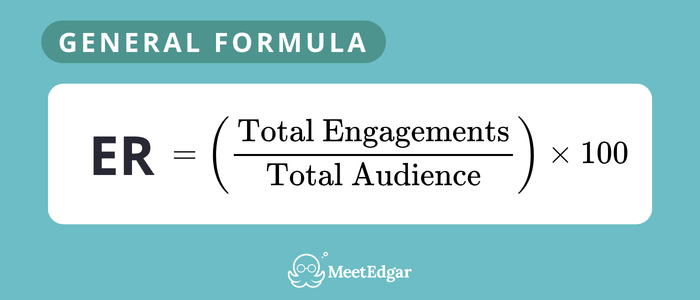
Before we dive into the specifics, let's look at the foundational concept. The basic formula to measure engagement rate is:
Engagement rate = (Total interactions / Total audience) x 100
Example
If a post gets:
- 250 total interactions (likes + comments + saves)
- 5,000 reach
Then:
Engagement rate = (250 / 5,000) x 100 = 5%
That means 5% of the people reached interacted with the post.
You get a percentage. That percentage tells you the proportion of your audience doing something beyond scrolling past.
Here’s the secret, though: there is no single "correct" formula that works for every brand, campaign, or platform.
The way you calculate your engagement rate depends entirely on what you are trying to measure and how you define your "audience.
What counts as an engagement?
Before calculating anything, you need to decide what goes in the numerator. Engagements typically include:
- Likes / reactions
- Comments
- Shares / reposts / retweets
- Saves / bookmarks
- Clicks (link clicks, profile visits, hashtag clicks — depending on the platform)
- Video views (sometimes, though views are also used as a denominator — more on this below)
- Direct messages or replies (on some platforms)
- Poll votes / sticker interactions (Stories, etc.)
When calculating your total engagements, you'll typically add these metrics together. The most common version uses likes + comments + shares.
Just be consistent. The formula matters less than applying it the same way every time so comparisons hold up.
Common methods to calculate engagement rate
As mentioned earlier, there are several ways to calculate engagement rate, and the right method depends on what you want to measure.
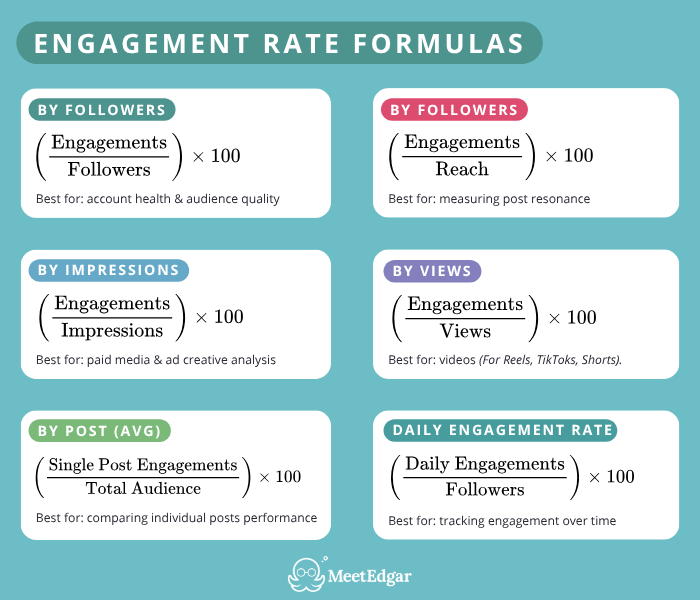
Below are six of the most common ways to measure social media engagement rate.
1. Engagement Rate by Followers (ER Followers)
This is the most common and straightforward way to calculate engagement. It measures how your content performs relative to your total follower count.
Formula: (Total Engagements / Total Followers) x 100
Use this formula when you want to understand how engaged your follower base is overall.
2. Engagement Rate by Reach (ER Reach)
Many marketers consider this the most accurate representation of content performance. It measures engagement against the number of unique individuals who actually saw your post.
Formula: (Total Engagements / Total Reach) x 100
Use this formula when you want to know how compelling your content was to the people it reached.
3. Engagement Rate by Impressions (ER Impressions)
This formula is particularly useful for paid advertising campaigns where you are paying per thousand impressions (CPM). It helps you understand how effective your ad is at generating action every time it appears.
Formula: (Total Engagements / Total Impressions) x 100
Impressions count the total number of times your content was displayed on a screen, regardless of whether it was clicked or not. This includes repeat views by the same person.
4. Engagement Rate by Views (ER Views)
This version is especially helpful for video and commonly used for TikTok, Reels, Shorts, and YouTube because views are often the clearest top-line indicator of consumption.
Formula: (Total Engagements on Video Post / Total Video Views) x 100
5. Engagement Rate by Post (ER Post)
This formula is ideal for comparing the performance of specific content types (e.g., video vs. image, or different campaign posts) against your follower count, offering insights into what resonates best with your core audience.
Formula: (Total Engagements on a Specific Post / Total Followers) x 100
To get an average for multiple posts:
Average ER per Post = Sum of Post Engagement Rates / Number of Posts
6. Daily Engagement Rate (Daily ER)
Instead of looking at individual posts, this metric looks at how your audience interacts with your brand on a daily basis.
Formula: (Total Engagements in 24h / Total Followers) x 100
Here's a cheatsheet with all formulas:
Which formula should you use?
The formula you use should reflect the question you're trying to answer. A good rule is:
- use followers when you want to understand how engaged your audience base is
- use reach when you want to know how compelling a post was to the people who actually saw it
- use impressions when you are comparing efficiency across organic and paid exposure
- use views for video-first platforms or video-heavy campaigns
Engagement rate formulas by platform
Different platforms call things by different names and make different data available.
To make things easier, here is a breakdown of how to calculate the two most common engagement rates (by Followers and by Reach) across the major social media platforms.
A few platform-specific notes worth keeping in mind:
TikTok's algorithm-first distribution means follower-based rates can be misleading — your followers may not be the primary audience for any given video. View-based engagement makes more sense there.
LinkedIn's impressions include feed displays to non-followers, so reach-based engagement tends to run lower than expected.
Pinterest functions more like a search engine than a social feed, so saves (Pins) carry more weight than comments when evaluating content performance.
2026 social media engagement benchmarks
So, what is a good engagement rate? The honest answer: it depends.
On the platform, the niche, the account size, whether you're measuring by followers or by reach — all of it.
Engagement rates vary significantly by platform due to different algorithm priorities, content formats, and user behaviors
However, to give you a baseline, here are the average engagement rate benchmarks for 2026:
- TikTok: 3.5% – 5.0%
- LinkedIn: 2.5% – 4.0%
- Instagram: 0.5% – 1.5%
- Facebook: 0.1% – 0.5%
- X (Twitter): 0.05% – 0.1%
Don't panic if your Facebook engagement is 0.3%—that's actually above average! Use these numbers as a starting point, but focus primarily on improving your own historical average.
If your Instagram engagement was 0.8% last month and 1.0% this month, you are moving in the right direction. Focus on creating valuable content, posting consistently, and engaging genuinely with your community.
Turn Engagement Data Into Better Content
Once you know how to measure engagement rate, the next step is simple: do more of what works.
If certain posts consistently earn clicks, saves, comments, or shares, they should not disappear after one publish date. They should be reused, repurposed, and built into your long-term content strategy.
MeetEdgar helps you do exactly that. With automated scheduling and evergreen content recycling, you can keep your top-performing posts in circulation and stay active without starting from zero every day.
So if you want to improve your engagement rate, do not stop at measuring it. Use those insights to create a content system that keeps working over time.